Hello and welcome to the Surfer's Guide to Your First Wing Equipment
Wing is a brand new sport, so surfers from all disciplines and with different experiences are entering the sport. Because of that, we are allowed to divide it up a bit.
Beginners – People with no previous water sports experience
Surfers – Windsurfers, kiters and wave surfers who have board experience before
Foilers – Have experience with foil from other disciplines such as kite, windsurfing or behind a boat.
Depending on which group you feel at home in, our recommendations will look a little different.
Board
When buying your first board, the volume is the most important thing to consider, you should choose a board with enough buoyancy to make it easy for you at the beginning.
Beginners would be wise to choose a board with 20-40 liters more volume than you weigh in kilograms. So a Rookie of 80kg should choose a board of 100-125 L. More volume gives more stability to stand on the board when you are not on the foil, but you grow out of it a little faster once you are on it and riding the foil regularly. An inflatable board usually has even more volume due to the thickness required to make it stiff enough.
Surfers can take advantage of their board experience and choose a slightly smaller board that will be more maneuverable once you are on the foil, but at the expense of stability. An 80kg surfer should look at a board with 90-110 L volume.
Foilers will probably spend very little time learning the foil and can therefore choose a board that has relatively low volume for maximum maneuverability. An 80kg foiler can choose a board between 80 and 95 liters depending on preference.
All boards except some inflatable models have holes for mounting straps, so whether you want to use them or not is a personal choice. However, we would recommend that as a beginner, ride without straps at first to feel that it is easier to find where you want your feet and that you can easily get rid of the board when you fall.
Foil
The foil mainly consists of 4 parts. Mast, fuselage, front wing and rear wing.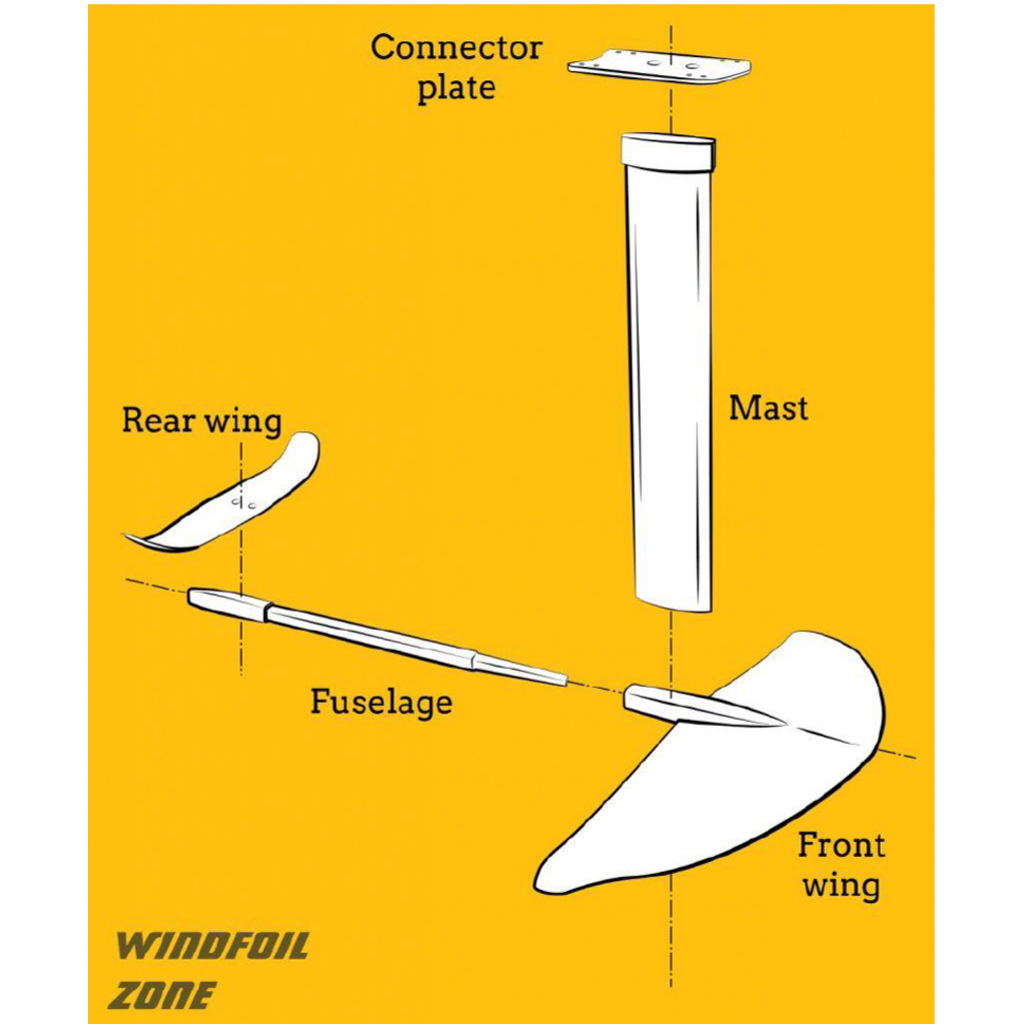
The mast is the part that connects the board to the foil itself. It comes in different lengths and is made either of aluminum or composite materials such as carbon fiber.
Beginners should choose a slightly shorter mast that makes it easier to control the foil and provides a lower drop height when crashing. 70-80cm is a good start.
Surfers and Foilers can choose a mast according to preference and the places they ride. 75 to 90cm. A longer mast gives better opportunity to parry waves and chop on the way out and gives more room for small mistakes, but a shorter mast gives more contact with the waves when surfing them. 82/85cm is the most common length.
The fuselage is the part that the wings and mast attach to. This part is always under water when riding. Usually made of aluminum, but there are also models in carbon fiber.
.
With some manufacturers you can choose the length of the fuselage and with others there is only a set length. The length affects the stability and turning ability of the foil. A longer fuselage is more stable and a shorter one is more reactive and turning.
Please talk to us for more details about the foil you are interested in.
The rear wing or "stabbe" is the small wing at the back of the fuselage. It is almost always made of carbon fiber and has a big impact on how a foil feels.
Many foils are sold complete with a front wing and rear wing that are matched to each other. In cases where each part is sold separately, just contact us for personal help. If you later want to change any feature, it is often enough to change to a rear wing with a different design.
The front wing is simply the large wing at the front of the foil. It determines a lot, such as lift, glide, speed and turning behavior.
A large wing generally provides more lift than a small wing, and that is all a Beginner needs to think about. But of course it is not that simple, there are many parts of the design that come into play. Here Surfers have the opportunity to choose something that fits with their previous background and a Foiler can find the performance and feel that is required.
A Beginner of 80kg should choose a foil with 1700-2000cm2 area on the front wing. If you are riding in fresh water and/or in lighter winds, you should choose something in the upper range.
A surfer weighing 80kg can choose a foil with 1400-1800cm2 area on the front wing. Here, you should also think about how you want to develop your surfing and choose a foil that is suitable for the purpose.
Foilers have both size, design and previous experience to take into account. If you weigh 80kg, anything from under 1000cm2 up to 1800cm2 will work. It depends entirely on how you want it to feel under your feet. However, we recommend not choosing one that is too large if you are riding in salt water, stronger winds and/or in the waves.
Wing
Size, boom vs. handle, bottom drag, stiffness, canopy tension, windows, etc. There are many things that differentiate the different wings, but for those of you who are going to buy your first wing, the most important thing to think about is the size.
Size – Depends largely on where you are going to ride and how much it usually blows there. For example, here in Varberg it often blows 7-10 m/s and therefore many ride with 4.5-6m2 large wings. But in Stockholm where it usually blows a little less, it is more common to ride a 6-7m2 large wing.
Of course your weight also plays a role, but not as much as the wind strength.
You get a long way with one size, a wing of about 6m2 is enough from about 6-10m/2, but to ride as many days as possible you often need 2. A larger one for lighter winds and a smaller one for stronger winds. With e.g. a 6m2 and a 4m2 wing, an 80kg person can ride from about 6m/2 up to about 14m/2.
Handles – Right now there are soft handles, hard handles and booms to choose from. Which is best is up to you. It is a matter of preference and personal comfort. All options work great. Soft handles are available on the Naish wings. Hard handles on the Cabrinha and Duotone Unit and booms on the Duotone Slick and Echo.
A fixed boom weighs a little more, which means that the wing drifts a little worse when you hold it by the handle at the front of the wing and it is therefore not optimal if you plan to surf waves. But it is not something you need to think about so much when it is your first wing.
Other things
You need a leash to avoid losing your board and wing. The leash for the board is attached either around the ankle, around the calf below the knee or around the waist. All work well, it's just a matter of taste. We have all the options.
The leash for the wing is attached either around the wrist or to the waist belt. It usually comes with a leash when you buy the wing, but for some models you have to buy it separately. Then choose the length according to the size of the wing. Larger wings need a longer leash.
To inflate your wing, you need a pump. All manufacturers have their own connection, but it usually comes with an adapter that makes most pumps fit most wings. The exception is Duotone, which requires you to use their own pump hose.
Safety equipment - Remember that the board is hard! Please wear a helmet and protective vest/impact vest.